All articles
How Winning B2B Brands Ditch One-Off Campaigns To Build Always-On, Video-First Growth Systems

Melissa Rosenthal, Co-Founder of Outlever and former Chief Creative Officer at ClickUp, built a system where video drives both brand and performance from day one.
Video wasn’t just a format for us. It became the infrastructure for how we told every story and built the brand.

Co-Founder
Outlever
B2B content has never been easier to produce, and it's never been harder to stand out. Generative AI has turned content into a volume game, flooding the market with polished, forgettable messaging. The companies breaking through are building around a different core, aligning brand and performance from day one and using video as the operating layer that drives how they show up, scale, and stay top of mind.
Melissa Rosenthal, Co-Founder of Outlever, helps brands build owned media networks that turn content into a core driver of growth. Her past leadership roles include Chief Creative Officer at ClickUp, Chief Revenue Officer at Cheddar, and Global VP of Creative at BuzzFeed, where she helped launch digital-native ad products that generated more than $50 million in their first three years. She later helped scale Cheddar to a $200 million acquisition. At ClickUp, that experience informed a video-first approach, where content operated as the central engine behind the company’s marketing and growth efforts.
"Video wasn’t just a format for us. It became the infrastructure for how we told every story and built the brand," Rosenthal says of her time at ClickUp. "Every single thing we knew we needed to do as a part of our go-to-market strategy revolved around video. It was our North Star of how we communicate and tell stories." Building that kind of system requires more than creative ambition, it depends on executive alignment. In many organizations, brand and performance operate on separate tracks, creating tension between long-term storytelling and short-term results. Without clear top-down support, those efforts tend to fragment into disconnected initiatives, making it difficult to sustain a cohesive narrative over time. "Performance marketing fuels growth, but brand is what lights the fire in the first place," she adds.
Mandate whiplash: Rosenthal built the ClickUp marketing model by bringing brand and performance into alignment from the start. She applied a CRO lens to the work, focusing on customer acquisition costs, lifetime value, and payback periods, while using performance marketing to capture immediate demand. To ensure that momentum didn’t fade, she paired that with a system designed for consistency, backed by executive support and close coordination between brand and growth teams. "When marketing is siloed from decision-makers, it creates a vacuum," she explains. "That results in people doing a lot of tasks that never ladder up to anything, and pivoting every minute because there's a new mandate. That doesn't build anything."
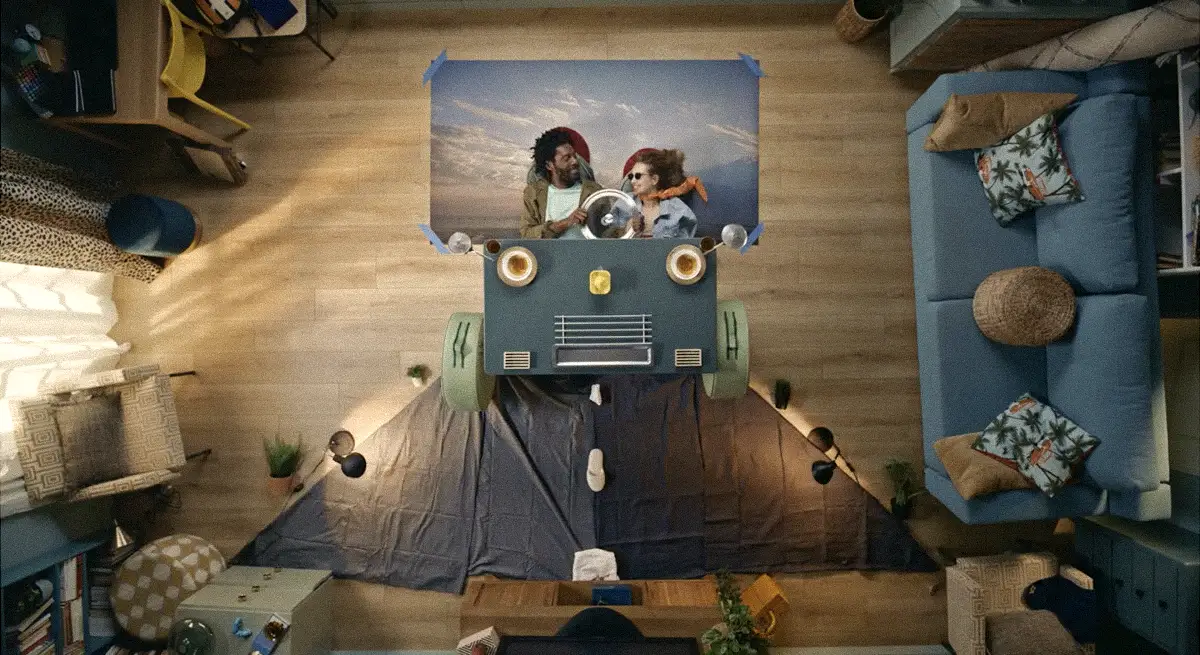
50 shades of creative: The execution comes down to what Rosenthal calls "parallel pathing," building brand and performance assets at the same time. Instead of treating campaigns as single outputs, her team structured them as systems, with one core idea feeding multiple use cases. The Cavemen campaign at ClickUp is a clear example, designed to work across both awareness and conversion. From there, the team created a production model that could generate dozens of variations, each tailored for different formats and performance goals. "We parallel-pathed everything," she explains. "Every piece of creative that went out the door had different versions for both purposes. We created about 50 versions of that ad very intentionally, shooting them vertical-style for performance, with a person to camera explaining the problem, solution, and pain point."
To break through in B2B software, Rosenthal focused on humanizing the category. That meant moving beyond features and positioning work as a lived experience, shaped by interactions, routines, and moments that extend beyond the product itself. "Work is your life, but it's also your off-time, your colleagues, the water cooler, and all the stuff that happens around work," she says. "If we can become synonymous with those conversations, we're going to win."
The SNL treatment: Rosenthal leaned into calculated risk with a series of SNL-style competitor ads aimed at Jira and Atlassian. Knowing the work would divide opinion, she aligned leadership early by defining acceptable sentiment ranges, creating space to experiment with creative designed to spark reaction. In a crowded B2B landscape, the bigger risk is going unnoticed. "In a world where things are all a sea of the same, creating discourse is the most valuable thing you could be doing," she notes. That thinking now shapes how content is evaluated before it goes live. "If you're not looking to create discourse, then why ever publish something? The only thing that is going to be valuable is the stuff that gets people talking."
From funding to fame: For venture-backed software companies, standing out is increasingly tied to the pressure of growing into their valuations. As AI commoditizes both software development and content production, the efficiency of paid performance continues to decline, even as funding expectations remain high. Outside of a small group of AI-native companies benefiting from product-led virality, Rosenthal sees brand as the primary lever for creating the awareness and momentum needed to support those valuations. "To be a $20 billion company, the entire market has to know who you are," says Rosenthal. "You're not going to achieve that through performance marketing and word-of-mouth alone."
As AI lowers the cost of production, the advantage shifts from output to taste. Content is easier to produce and distribute, but much of it still blends together, making memorability harder to achieve. Rosenthal sees an opening for companies willing to take measured creative risks and build systems that prioritize human emotion over interchangeable execution. "I look at a lot of brand marketing that people are proud of, and it doesn't say anything," she observes. "I didn't laugh and I didn't feel anything after watching it. People need to feel something to remember it." In this new environment, the work that stands out is the work that feels familiar and personal, creating an immediate point of connection with the audience. "If you watch something and immediately recognize yourself, your co-founder, or your colleague, that's where you win," she concludes. "There's a natural psychological attachment, but it has to feel human."