All articles
Educational Content Gains Ground As Audiences Experience 'Hard Sell Fatigue'
Claire Braud, Content Strategist at Cloosie, says hitting conversion goals today rests on content that centers the audience, not the brand.
I use the audience as the center of everything that I do. If you’re centering yourself as a brand instead of your user, you’re missing the opportunity to actually connect and build trust.

Content Strategist
Cloosie
Educational content is becoming a stronger growth engine as audiences get better at spotting the sell. In a feed already crowded with pitches, brands earn trust by showing up when customers need help, not when the company wants attention. The brands that answer real questions first are the ones customers remember when it’s time to choose.
Claire Braud, a Content Strategist at Cloosie, says that while the direct sales approach may work on a balance sheet, it's not so successful in today's social reality. A former on‑air sports reporter, she leans on her journalism roots to keep the audience at the center of enterprise marketing. In her most recent corporate position at Blue Cross Blue Shield of Arizona, she averaged 116% of conversion goals across business lines by answering real questions, using AI as a testing ground rather than a ghostwriter, and bridging the gap between what executives want to say and what customers actually need to hear.
"I use the audience as the center of everything that I do. If you’re centering yourself as a brand instead of your user, you’re missing the opportunity to actually connect and build trust," Braud says. What she suggests is that pivoting from the hard sell isn't just important for building sales potential. If brands don't work on standing out by being useful to their audience now, they risk losing the trust that leads to long-term loyalty.
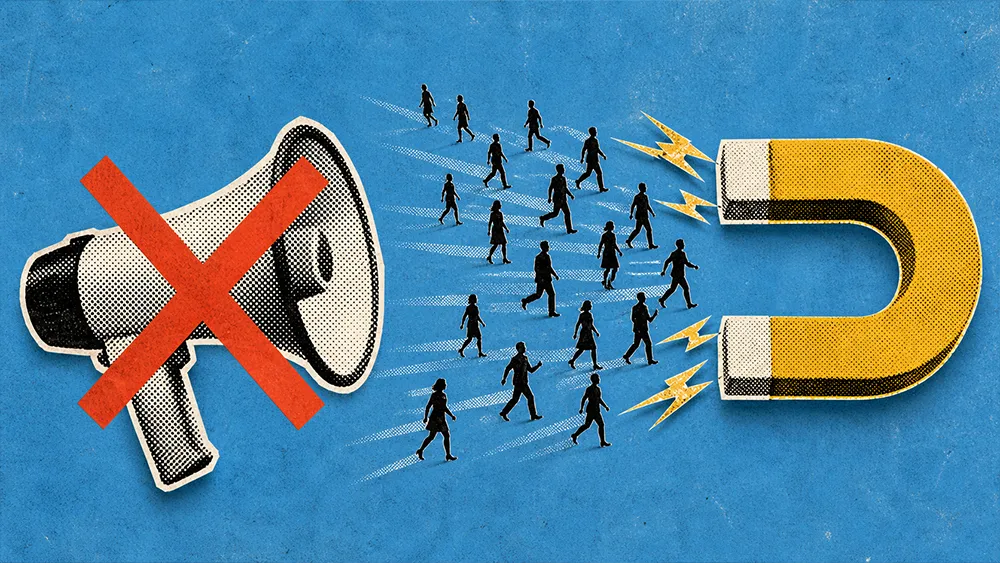
The slot machine feed: "I open my phone, I open TikTok or I open Instagram, even if I'm just going to read the news, and there's just ding, ding, ding, ding, ding. It's like a casino," Braud says. "It's exhausting, and people are burnt out on feeling like every bit of their time and every space that they're in needs to be capitalized on by some type of company." She suggests a helpful reframe of building content for connection rather than conversion.
Narrative that sells softly: She points to Bombas’ 2016 One Million video, a short film about a man getting a tattoo to mark the company’s first million pairs of socks donated to homeless shelters, as an example of content that drives action without centering on product. “It’s one of my benchmark examples of good narrative marketing that doesn’t feel like marketing,” Braud says. “It doesn’t center on product. It centers on mission and the good they’re trying to do in the world. That’s the kind of story that can convert someone who’s not in the market to buy socks into buying three pairs.” In a noisy, AI-accelerated market, that’s the bar Braud sees more brands needing to reach: useful, human, story-led video content that earns attention before it asks for a sale.
That same principle shows up in Braud’s own work: build enough trust that a transaction doesn’t have to come first. The goal is to make content useful enough that people return to it on their own terms. She put that playbook to the test during a recent Medicare age-in campaign at AZ Blue.
A narrative shift: Health insurance is a low‑interest category, and internal stakeholders often default to assumptions about older adults being offline and mail‑driven. Braud pushed for a different view, pointing to her own parents in their seventies as an example of the tech‑savvy, active audience the brand needed to reach. "We shifted the messaging away from cost and toward identity," Braud says. "This audience aging into Medicare didn't necessarily think of themselves as aging, they think of themselves as entering a new stage as very active adults."
Help, don't hustle: Instead of driving hard toward a plan selection, her team designed an email strategy to help people navigate an unfamiliar decision. 'We crafted this entire email journey with cost analysis tools and a quiz to understand which type of Medicare would be right for your life," she says. "We've woven our value propositions throughout, but the whole of it was: how can we make you feel comfortable making decisions you've never had to make before?" Braud's team designed the strategy to help customers learn more about an unfamiliar life stage and build trust with AZ Blue in the process.
Since this is a relatively new strategy in the marketing world, getting the C-suite to sign off requires its own playbook. Braud navigates the disconnect that can often emerge between some decision‑makers and their audiences by using AI: not to write copy, but to accelerate the research she needs to make a case.
Speed-running the C-suite: Making the case for investing in an educational rather than salesy content strategy is more easily accepted when backed by data. "If you can pull together a quick research case of how seniors are using the internet, or cell phone breakdown by age bracket, what different apps are being used, and bring that back to those leaders and back that up, you can more often than not get them to, at the very least, test a new idea," Braud says. "Sometimes it is just figuring out, okay, well, we can do it that way, but can we also add this in and just see how it goes? And that's a much easier way to appease people."
Command-V casualties: Braud treats AI as a pressure-testing tool, not a replacement writer. She builds a detailed customer profile, gives the model the person’s life circumstances, knowledge level, and relevant context, then asks it to review her drafts from that point of view. “I give it instructions to act as someone going through this experience who knows nothing about this topic,” Braud says. “Then I ask it to read what I’ve produced and tell me what’s missing, what it doesn’t understand, what’s not resonating.” When she does use AI to generate options, the output stays in draft territory: “You can tell when content has been generated by AI and they just decided to copy and paste. If you use it as a starting point and ask the AI for three variations of this piece of content, then massage it to your voice and tone and the way that you would use it, you can really streamline things.”
The incorporation of AI into content teams' processes is also changing how marketing job descriptions are written. As AI application moves from hyper-targeted ad systems that make feeds read like pure commerce to new ad products inside chat interfaces themselves, Braud notes that titles like "content strategist" are currently inconsistent with companies demanding "AI-native" talent. Braud pushes back on this shift, arguing that the safest career bet for marketers right now is to double down instead on irreplaceable human storytelling.
Future-savvy strategists understand AI is crucial to building a scalable engine, but human-led narrative is what makes the strategy come alive. "I am seeing a lot of talk that you need to be AI‑native or regularly use AI tools. It's understandable, but no one's AI‑native. We're still in an infant stage when it comes to tool application," Braud says. "I think the market is going to shift a lot towards people who are good storytellers, as opposed to people who are good content strategists. The story is going to become a lot more significant because that is something AI tools can't necessarily replace."